درخواست جمع کرانے کی آخری تاریخ جمعہ،27فروری،2020
پاکستان پریس فاوٗنڈیشن (پی پی ایف)نے پاکستان میں میڈیا کی آزادی اور حفاظت کے فیلو شپ پروگرام کے لیے درخواستیں وصول کرنے کا اعلان کردیا۔
اس فیلو شپ پروگرام کا مقصد آزادی اظہار رائے کو فروغ دینا اور میڈیا کارکنان کو مدد فراہم کرناہے تاکہ وہ میڈیا کی آزادی اور صحافیوں کے تحفظ سے متعلق مسائل پر رپورٹس تیار کرسکیں ۔
اس فیلوشپ پروگرام میں دو ورک شاپس منعقد کی جائیں گی اور اس کے ساتھ ادارتی اور تکنیکی تعاون بھی دیا جائے گا تاکہ میڈیا کارکنان کی حفاظت پر ،اخلاقی ، قانونی ور پیشہ ورانہ صحافت کے بہتر ین معیار کے مطابق رپور ٹس تیار کی جائیں۔منتخب افراد میں سے ہر فرد کو فیلوشپ پروگرام کے دوران چھ رپورٹس تیار کرنا ہوں گی۔ان افراد کو زیادہ ترجیح دی جائے گی جو صحافیوں کو قتل یا زخمی کیے جانے کے مخصوص واقعات پر تفتیشی رپورٹنگ کریں۔
منتخب افراد کو سینیئر صحافیوں کی معاونت میں رکھا جائے گا جو اس فیلو شپ پروگرام کی مدت تک ان افراد کے ایڈیٹر کے فرائض انجام دیں گے۔
صحافی جو پرنٹ،ٹیلی ویژن،ریڈیو یا آن لائن میڈیا میں کم سے کم تین سال کا تجربہ رکھتے ہیں وہ اس پروگرام کے لیے درخواست دے سکتےہیں۔خواتین صحافیوں کی درخواست جمع کروانے کی حوصلہ افزائی کی جائے گی۔
بلوچستان،فاٹا،گلگت بلتستان اور آزاد کشمیر سے تعلق رکھنے والے صحافیوں کے لیےاہلیت کی بنا پر شرائط میں نرمی رکھی جاسکتی ہے۔
اس فیلوشپ پروگرام کی مدت تین ماہ ہے اور اس پروگرام میں منتخب افراد کو ساٹھ ہزار روپے(60,000)ادا کیے جائیں گے۔
،درخواست گزار کے لیے درج ذیل کاغذات بھیجنا ضروری ہی
Pakistan Press Foundation (PPF) has issued a call for applications for Fellowship program on
Media Safety and Impunity in Pakistan.
The fellowship program aims to promote freedom of expression by providing support to media professionals to produce stories related to issues on Media Safety and Impunity.
The fellowship programs will include two capacity building workshops as well as editorial and technical support to produce reports on safety of media practitioners that meet professional, ethical and legal best practices in journalism. Each selected fellow will have to produce up to six stories during this fellowship program. Preference will be given to fellows who will commit to investigating impunity for specific cases of journalists killed or injured.
Selected fellows will be paired with senior journalist who will act as fellowship editor during the period of fellowship program.
Journalists having minimum experience of three years working for print, television, radio and online media can apply for the fellowship program.
The criteria for journalists from Baluchistan, FATA, Gilgit-Baltistan and Azad Kashmir may be relaxed for otherwise qualified applicants. Female journalists are encouraged to apply.
The duration of the fellowship is three months and the amount for the fellowship is sixty thousand rupees.
Applicants must send:
• Professional resume/CV with recent photograph
• Story proposal form for stories (for story proposal form click here)
• Application form (For application form click here)
• Three links/samples of published or broadcast pieces.
• Applications should be sent to [email protected]
The deadline for submitting applications is Thursday, February 27, 2020. Applications received after the due date will not be entertained.
Last date for receiving applications: Sunday January 5, 2020
Pakistan Press Foundation (PPF) invites applications for the 7th batch of PPF Investigative Reporting Fellowships.
The fellowships facilitate Pakistani journalists to produce investigative report that meet the professional, ethical and legal standards. PPF will provide support to journalists, to professionally investigate and report on issues relating to human rights, transparency, environment, inequity, governance and corruption.
The fellowships will include capacity building workshops as well as editorial and technical support. Selected participants will work under the supervision of a senior journalist who will act as fellowship editor. Each fellow will be expected to produce up to six stories during this fellowship program.
Journalists with a minimum experience of three years working for print, television, radio and online media can apply for the fellowships.
The criteria for journalists from Baluchistan, FATA, Gilgit-Baltistan and Azad Kashmir may be relaxed for otherwise qualified applicants. Female journalists are encouraged to apply.
The duration of the fellowship is three months and the amount for the fellowship is sixty thousand rupees.
Completed application forms, in either English or Urdu, containing the following must be received by Sunday January 5, 2020 to be considered for the award of the fellowships.
Fellowship application form
Professional resume/CV
Stories proposal form
Links or clippings of at least three articles that were published or aired in the last three years.
پاکستان پریس فاؤنڈیشن (پی پی ایف) کی جانب سے فیلوشپ برائے تحقیقاتی رپورٹنگ کے ساتویں بیچ کے لئے درخواستیں موصول کی جارہی ہیں۔
فیلوشپس میں صلاحیت سازی کے لیے ورکشاپس کے انعقاد کے علاوہ ادارتی اور تکنیکی معاونت بھی فراہم کی جائے گی۔ منتخب امیدواروں کو سینئر صحافی کے ساتھ کام کرنے کا موقع ملے گا جو فیلوشپ کے دوران پراجیکٹ ایڈیٹرکاکردارادا کریں گے۔ فیلوشپ پروگرام کے دوران ہر جرنلسٹ کو چھ رپورٹس تیار کرنا ہوں گی۔
پرنٹ، ٹیلی ویژن، ریڈیو اور آن لائن میڈیا میں کم از کم تین سال کا تجربہ رکھنے والے صحافی فیلوشپس کے لیے درخواستں جمع کروا نے کے اہل ہیں۔
بلخصوص بلوچستان، فاٹا، گلگت بلتستان اور آزاد کشمیر کے صحافیوں کو اہلیت کے معیار میں رعائیت دی جا سکتی ہے۔ خواتین صحافیوں کی درخواست دینے کے لئے حوصلہ افزائی کی جاتی ہے۔
فیلوشپ پروگرام کا دورانیہ تین ماہ اور فیلوشپ پروگرام کا وظیفہ ساٹھ ہزار روپے ہے۔
فیلو شپ کے حصول کے لئے ،انگریزی یا اردو میں مکمل شدہ ،مندرجہ زیل دستاویزات کا 25 جنوری، 2020 کو شام 5:00 تک موصول ہونا ضروری ہے۔
BBC Urdu’s flagship radio programme about current affairs Sairbeen will fall silent on Dec 31 this year and will not see the New Year after having been on air for 51 years.
BBC Urdu Service head Mehvish Hussain has attributed the decision to falling short wave and medium wave audiences and the “migration” of younger media users and women to digital platforms including television. The BBC says its decision is based on audience research conducted last year.
The nostalgia around Sairbeen is very strong among a generation of listeners who tuned in each evening at or around 8pm in Pakistan, half an hour later in occupied Kashmir and at 7pm in the United Arab Emirates over several decades.
Through years of dictatorship and censorship in Pakistan, Sairbeen provided a lifeline to the audience, as it was perhaps their only means of understanding what was happening in their own backyard. Its current affairs content was carefully compiled to meet their needs.
The audience responded with equal commitment. From events in 1970-71 when people in West Pakistan were told all was well in the eastern wing to the coup in 1999, Sairbeen had a devoted listenership, with some 20 million people tuning in each week.
Programme to be faded out on New Year’s eve
It was also the programme that turned accomplished broadcasters and journalists such as Athar Ali, Viqar Ahmad, Raza Ali Abidi and Asaf Jilani, among others, into household names in the subcontinent. These broadcasting giants and their colleagues ensured their output was credible and the listener showered them with adulation, and took their word as gospel.
Later the programme was to be hosted by Shafi Naqi Jamie, Ali Ahmed Khan, Obaid Siddiqui, Wusatullah Khan, Nayeema Ahmad Mehjoor, Mahpara Safdar, Mohammed Hanif, Zubair Ahmad, Nusrat Jahan, Eilya Haidar and Javed Soomro.
My own relationship with it morphed into something new with the passing years. It started when I was a college student and Gen Ziaul Haq overthrew an elected government and imposed martial law, and continued till the judicial farce that led to the sentencing and execution of then prime minister Zulfikar Ali Bhutto.
I remember all through that period, then the formation of the MRD, the PIA hijacking to the launch of the MRD movement in 1983, one tuned in before dinner to get a sense of what was happening in our own country. Kashmiri friends in Srinagar and in the rest of the occupied valley talk of a similar experience.
If the MRD movement pressured Zia to move from outright autocratic rule to a watered down, non-party democratic order, one journalist chronicled that movement. Iqbal Jafri’s despatches from Sindh, which were at the heart of the resistance, kept the listeners abreast of the developments daily.
With the Soviets marching into Afghanistan in 1979, Rahimullah Yousufzai was to become the go-to man for any information on what was happening as the Pakistan- and CIA-trained and Saudi-funded ‘mujahideen’ took the battle to the Red Army. His voice became synonymous with credible reports on the landlocked, strife-torn country.
Zaffar Abbas, Idrees Bakhtiyar, Shahid Malik, Ali Hassan, Haroon Rashid, Azizullah Khan, Shakil Akhtar, Omar Farooq, Ram Dutt Tripathi, Yusuf Jamil and Altaf Hussain were other journalists whose voice reports from across the subcontinent were a source of credible information for a generation of Sairbeen listeners.
As a journalist I was asked to join the reporting team that was covering the elections in 1993. The following year the BBC offered me a job in London and I cut my teeth on Sairbeen under the stewardship of Viqar Ahmad (working weekends) after having been trained in the basics of broadcasting by Rashid Ashraf.
I worked on the programme when it went from half an hour to an hour. And then a year later as Service Editor integrated the whole 60 minutes into a rolling news and current affairs programme with a dedicated editor, by and large dispensing with translated despatches and relying on voice reports, interviews and radio packages.
The days such as the one I now recall must have happened innumerable times during Sairbeen’s life but I must share this personal experience. When we went on air on Oct 12, 1999, Gen Pervez Musharraf had been sacked as the army chief and by the time we concluded the programme an hour later, Musharraf was the country’s new ruler. Journalism does not get any more exciting and challenging.
A listener once wrote in from Drigh Colony, just across from the Karachi airport, to say that when his TV transmission was interrupted he sent his son running to get battery cells for his transistor radio. “From so many miles away you told me what was happening in my own neighbourhood. Can’t thank you enough.”
In a week’s time, the presenter will say: Aur iske saath he Sairbeen ka yeh Ikkeyavun [51] saala silsila ikhtetam ko pohncha. Khuda hafiz aur shab bakher
KARACHI: What happens if you expose the white collar crimes of influential people? If you’re a journalist in rural Sindh, you might end up being charged with kidnapping for ransom or extortion under the Anti-Terrorism Act (ATA).
Over 30 FIRs have been registered against 50 journalists in different districts of the province, including Nawabshah, Naushero Feroze, Jacobabad, Khairpur, Sukkur and Thatta, since May 2019.
“I know how to write,” said Ajeeb Lakho, a former president of the Ghambat Press Club. “I just know how to highlight issues of public interest that the people want to know about, so that the authorities can take action.”
Sixteen cases, including ATA cases, have been lodged against Lakho at different police stations in Larkana, Shikarpur, Naushero Feroze and Khairpur since May 23. The FIRs include charges of kidnapping for ransom and extortion.
Meanwhile, four cases have been registered against Imdad Phulpoto, a journalist in Sukkur, since 2017. “I am a journalist, not a kidnapper or a terrorist,” Phulpoto told The Express Tribune. “False and fabricated cases have been lodged against me and other journalists. But nobody actually listens to us because the people behind these cases are more powerful than the media.”
Of the cases lodged against him, two were registered in 2017, one in 2018 and one in July this year. The last FIR falls under the ambit of the anti-terrorism courts.
“Influential people want us to report according to their wishes. They want us not to disclose the truth about them to the world,” maintained Sahil Jogi, another Sukkur-based journalist. “Cases of attacks, kidnapping for ransom and other heinous crimes are constantly being lodged against those journalists who speak and write the truth.”
He added that four cases had been registered against him too, including two FIRs for attacks and robbery. All cases were registered at the Pano Aqil police station. He believed that the charges were meant to stop journalists from reporting facts. “This is creating some fear among media workers, but I don’t think it will work,” he stated.
Meanwhile, Phulpoto said that media persons were usually considered as people with influence in society. “In Sindh though, our voices are not being heard,” he added.
According to Ghazi Jhandeer, a journalist in Karachi, most of the cases have been registered in Sukkur and Khairpur districts. “Most of these cases are false cases of kidnapping for ransom,” he claimed.
Discussing the case against journalist Peeral Piasi, from Thatta, Jhandeer said that he was charged for extortion because of a story he wrote about gutka sales. “Interestingly, the complainant owns a gutka factory,” he narrated, adding that such cases were meant to serve as a warning for other journalists, telling them not to highlight these issues.
Issue raised
On Wednesday, the issue was raised during a meeting of the Provincial Public Safety and Police Complaint Commission chaired by Sindh Chief Minister (CM) Syed Murad Ali Shah.
Shah was informed by members of the commission that journalists in various districts were being booked in cases, including those pertaining to the ATA. When Shah asked Sindh IGP Dr Kaleem Imam about the matter, the provincial police chief claimed that he was not aware of the cases. He said he would share details about them in the next commission meeting in January.
Karamat Ali, a member of the commission, confirmed that the issue of FIRs against journalists was discussed during the meeting. He told The Express Tribune that it seemed that the cases were being registered due to the influence of powerful persons in the areas. “Most of the cases were registered in Sukkur division,” he revealed, expressing his hope that the CM would take action after the report.
“Journalists are facing many difficulties outside Karachi,” said Ali. “But their issues hardly get attention in the provincial capital.”
Journalists have staged demonstrations to protest the cases in various cities across Sindh, while some of those nominated in the FIRs also met politicians and senior police officials to discuss their plight.
NEW DELHI-Dozens of journalists in Indian Occupied Kashmir held a sit-in protest Thursday against an ongoing communication blackout in the region, describing the blockade of the internet and mobile phones as a government-imposed gag.
The journalists, holding placards and wearing black bands, said the Indian government was muzzling the press in the region and demanded that the internet and mobile connectivity be restored.
“End information clampdown”, “Stop criminalising journalists”, “Journalism is not a crime”, read placards held up during the silent protest.
A joint statement issued by 11 Kashmir-based journalists’ associations read: “How long can the journalists of Valley rely solely on official releases and occasional press briefings that have always been a one-way communication?”
For the last two months, mobile phone and internet services have been shut down in Indian-controlled Kashmir after New Delhi stripped the region of its semi-autonomous powers and implemented a strict clampdown. It has sent tens of thousands of extra troops to the region and detained thousands of people.
The authorities have said they have restored landline phones but have remained silent on when the mobile phones and the internet would be up and running.
On Oct 1 the Indian government challenged a petition filed by a Kashmir journalist on curbs on the media in Kashmir, saying there are no restrictions on the movement of journalists in the region. “Regular press briefings and press releases are being organised to disseminate information,” the government said in a counter-affidavit filed against the petition.
Authorities have set up a make-shift media communication centre for journalists at a private hotel in Srinagar. The information department managing the centre has allotted 15 minutes for each journalist to access the internet.
The internet blockade has also affected media operations in the region and most newspapers published from Srinagar have been unable to update their online editions since Aug 5, the date New Delhi stripped the region of its special powers.
Foreign journalists have been denied permission to visit the Himalayan region.
Earlier, The Kashmir Press Club, an elected body of journalists in Kashmir, had taken up the issue with the authorities and asked that mobile and internet services be restored for journalists.
UN human rights chief Michelle Bachelet said last month she was “deeply concerned” about the situation in the region.
The Indian government has provided an internet connection at a media centre set up for journalists, but reporters say this is insufficient and it lacks privacy. “There’s no privacy. Some 300 journalists use that facility daily and it is crowded. It is also being monitored and we are under surveillance,” said Ishfaq Tantray, general secretary of the Kashmir Press Club. A government spokesman in Kashmir was not immediately reachable for comment.
The president of the Kashmir Press Club, Shuja Thakur said that they had several times approached the Indian government in Kashmir for restoration of mobile and internet services for journalists. “They keep promising and say they are looking into it, but so far there has been no action,” he said.
Separately on Thursday, local media reported that opposition leaders in Jammu – where restrictions have already been eased to a greater extent – were after almost two months allowed to move out of their homes on Wednesday and resume their political activities.
The lifting of restrictions on movement of around a dozen top opposition leaders in Jammu comes ahead of local council elections in the state that are scheduled for Oct. 24, the Indian Express reported.
President Arif Alvi was served a notice by microblogging social media platform Twitter for posting in support of Kashmiris and highlighting the reality of the occupied valley after India’s illegal and unilateral move to annex the region.
Minister for Human Rights Shireen Mazari criticised the platform for “becoming a mouthpiece of the rogue Modi government” and lamented that the move was in”bad taste and simply ridiculous”.
The Twitter notice, however, mentioned that it has “investigated the reported content and could not identify any violations of the Twitter Rules or applicable law.”
Restrictions have been imposed in occupied Kashmir since India withdrew the disputed region’s special status under Article-370 and split the state into two Union Territories on August 5.
Pakistan has pledged to take the matter with India over Kashmir to every platform including the International Court of Justice.
Simultaneously, the government officials, journalists and activists have been using social media platforms, including Twitter, for showing their support of Kashmir freedom.
PTA approaches Twitter over suspension of Pakistani accounts
Recently, Twitter blocked over 200 Pakistani user accounts for tweeting in favour of Kashmiris and against India’s brutality in the valley.
On August 25, the minister had reacted again when a similar notice was sent to Minister for Communications and Postal Services Murad Saeed and had said, Twitter was trying to prevent “exposing of Indian fascism.”
Director-General Inter-Services Public Relations (ISPR) Major Gen Asif Ghafoor had earlier said the authorities were taking up with Twitter and Facebook the suspension of Pakistani social media accounts posting content in support of Kashmir.
“A few days before his death, I asked my brother why don’t you leave this risky and low-paid profession and go back to Korea to make your children’s future bright,” Nawab Gul recalls his last exchange with his deceased brother Javed Khan. “I was worried about growing attacks on journalists in the country. But he refused, saying it is a profession which provides him the opportunity to become a voice for the voiceless.”
Khan was a photographer for Daily Markaz. While reporting, he and a cameraman of the UK-based DM Digital TV were killed during an armed clash between law enforcement agencies and the students of Lal Masjid in Islamabad’s Aabpara area on July 3, 2007.
An eyewitness to Khan’s death, senior journalist Zafar Malik recounts that he, along with some colleagues, was standing at the roadside near the mosque while Khan was filming the violence when suddenly bullets struck, leaving Khan in a pool of blood.
As they rushed to rescue Khan, they were trapped in the shower of bullets as heavy gunfire erupted around them. “I felt like bullets were raining over them,” Malik shares of that most painful experience of his decades-long career.
The bullets marks can still be seen on the trees outside the school near Lal Masjid where Malik and his colleagues took shelter to escape the heavy firing. Although the government had made an announcement through the electronic media, warning journalists to stay away from the conflict zone in the tense stand-off leading up to the military operation, most had no idea about the announcement as they had been in the field from the early morning; they had no access to internet to keep themselves updated about the latest directions, explains Malik. While they were shifting Khan in a vehicle, bullets hit two other colleagues, leaving them injured.
Media personnel on the frontlines of conflict, including reporters, cameramen and photojournalists provide the images and information that media and readers most crave. But they are often also the most vulnerable. So why is so little being done to protect them?
The senior journalist says Khan’s death was taken simply as a collateral fatality; no FIR was registered against anyone for his death. He does not think that the deceased and injured journalists had been included in the list of the students who had been killed or injured during the later operation.
Absar Alam, who was bureau chief of Geo News at the time, was among the journalists who survived the crossfire between the law enforcement agencies and the students of Lal Masjid. “The lead up to the operation was like a frenzy,” recalls Alam. He was present at the conflict zone along with others to cover the developments. No one was thinking about anything untoward happening because the law enforcement agencies were making announcements asking Lal Masjid students to surrender peacefully. But all of a sudden, the protesting students became violent and started pelting stones on the security vehicles patrolling outside the mosque.
In the meantime, a stray bullet — Alam doesn’t know from where it came — turned the whole situation violent, and a crossfire began as the Lal Masjid activists were equipped with automatic weapons and stones. The gunfire was so sudden that everyone was trapped in the middle.
Alam didn’t know where his colleagues had gone; he just rushed towards the nearby school wall to escape the heavy shelling when a hard blunt object grazed his head. He began to bleed. He didn’t know which side it came from as the law enforcement personnel were positioned behind him on the rooftop of the school and the madrassah students were in the front of the mosque. He had nothing to shield himself from being hit further, as till then there was no concept in the Pakistani media of providing safety equipment to journalists who covered dangerous conflicts.
Alam pressed his head firmly with his hands to stop the bleeding and rushed towards the Poly Clinic Hospital where he luckily reached and had his wound stitched. Later, he was informed that Khan had been killed and some other colleagues were treated for their injuries. After that incident, a few media organisations started providing bullet-proof jackets and helmets to their reporters covering conflicts, but not all reporters and cameramen are equipped with safety equipment even today.
Living with disability
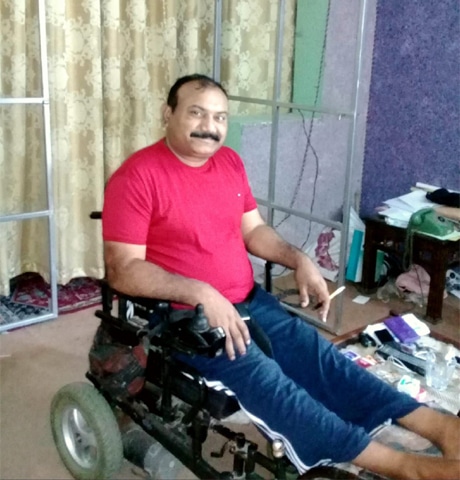
Israr Ahmed, a cameraman, is paralysed for life
Israr Ahmed, a cameraman for CNBC Pakistan, is another survivor of the unexpected clash before the Lal Masjid operation. Ahmed was covering an event when he received a call from his office to report the Lal Masjid stand-off. He went there immediately. “I was busy filming the gunfire outside the mosque when suddenly bullets hit me from the back. I don’t remember anything after that.” Three bullets hit Ahmed, leaving him unconscious in a pool of blood. Two bullets hit him in the arm and the leg. It was the third one, which pierced his spinal cord, that did the most damage. It left him paralysed for life.
At the time, his family was in pain due to his critical condition as he was on a ventilator, and his organisation too didn’t follow the criminal case. By the time he recovered from the near-fatal injuries, Ahmed says his case had been closed.
Two other photojournalists were also received gunshot wounds in the clash at Aabpara. Ahmed considers himself lucky as his organisation didn’t abandon him and provided the expenses of his treatment, but he rues that neither of their cases were prosecuted properly, despite the fact that they were simply serving their profession.
In their defence, Samaa TV — the successor of CNBC Pakistan — says it did all it could for Ahmed. Altaf Hussain, senior accountant in finance, administration and HR claims that his organisation provided 2.6 million rupees to Ahmed as immediate medical insurance. He points out that Samaa TV provides comprehensive health insurance of one million rupees to all employees based on the grade of employment, a policy that was formed at the time Samaa TV was launched in 2005. Hussain claims Ahmed is still on the payroll and entitled to the salary and other privileges that the organisation offers all its staff. The organisation also provides security jackets and helmets, raincoats, umbrellas and other related equipment to its field staff, he says.
Hussain also explains that he and Nadeem Malik, at that time the Islamabad bureau chief for CNBC Pakistan, had filed a complaint in person with the Aabpara police station regarding Ahmed’s incident. However, an FIR could not be registered due to unknown reasons. He says that the organisation can only support the family and that it did, adding that it was Ahmed’s family’s responsibility to prosecute the case as the organisation could not be a party in such cases.
I was busy filming the gunfire outside the mosque when suddenly bullets hit me from the back. I don’t remember anything after that.” Three bullets hit Israr Ahmed, leaving him unconscious in a pool of blood.
Justice denied
Javed Khan, a news photographer, died July 3, 2007
Javed Khan belonged to a middle-class family living in Charsadda district of Khyber Pakhtunkhwa province and his only source of income was his job. After his death, his family was left unattended financially. He left behind three young children — two daughters and a son — and a widow.
After his death, Khan’s brothers shifted the family to their native town in Charsadda as they were not financially sound enough to afford their living expenses in Islamabad.
While regretting moving his brother’s children from better quality educational institutions to a remote village school, Khan’s sibling Gul says that they had no other option but to bring them back. The family received 500,000 rupees only as compensation on behalf of the government, as well as another 100,000 rupees which he says either came as a donation from Khan’s colleagues or from the media organisation he was employed by.
Gul says he wished to prosecute his brother’s case and to bring the perpetrators to justice, but he could not afford to pay the lawyers’ fees or to make repeated visits to Islamabad for court hearings. Rather than spending their money on the prosecution of the case, he preferred to spend that money on his niece’s and nephew’s education. Gul has no idea whether the police even registered the case of his brother’s murder or not.
The police had called him once to record his statement in the initial days after his brother’s death but they never contacted him again. When he was giving his statement to the police, one of the questions the police asked Gul was about the kinds of activities the deceased used to engage in. Khan’s employers never got in touch with the family either.
On July 3 this year, the family observed Khan’s 12th death anniversary. On every death anniversary, Gul asks himself what his brother’s crime was, for which he had been punished. Was he not serving his country and organisation like others who not only get special acknowledgment for their services but are served with justice as well?
“I simply convince myself that my brother was punished for his honesty with his profession, and that the Almighty will give him his just rewards in the next life.”
Eos tried to approach the owner of Daily Markaz, Tahir Khokhar, Khan’s employer at the time of his killing, to find out what assistance his organisation had provided his family after his death. Khokar was unreachable. He had shifted to Germany after closing down his newspaper many years ago.
What does the law envisage?
Advocate High Court Malik Saleem Iqbal says the country’s laws clearly state that an FIR must be registered in cases such as those of Javed Khan. He explains that if the police shows reluctance to register a case, then the aggrieved party may invoke a sessions judge under Section 22-A of the Code of Criminal Procedure (CrPC).
Journalists, he says, may connect their duties to Article 19-A of the constitution, according to which every citizen is empowered to access certified information from public bodies. If any public body refuses to provide information, then the applicant may lodge a complaint before the Information Commission, under the Right to Information and Transparency Act, 2017. The concerned official may be penalised under the act. Any public body which creates hurdles in the access of information is actually committing an infringement of the constitution in the eyes of the law.
Threatening journalists is tantamount to a violation of the fundamental rights enshrined in the constitution. Journalists should be able to access information through law to deter unlawful acts of agencies and public bodies. Under law, all proceedings are documented and will be supportive in case of any unpleasant approach from officials of any public body. Moreover, the law states that Article 19 of the Constitution confers on all citizens the right to freedom of speech and expresses that there shall be freedom of the press, subject to any reasonable restrictions imposed by law.
Changing the outlook
Source: Pakistan Press Foundation (PPF)
According to statistics available with the Pakistan Press Foundation (PPF), 48 journalists have been killed in targeted attacks across the country in the last 17 years, of which 24 were killed in the line of duty. The accused in only five cases were convicted.
The report further reveals that cases were lodged in 25 violent incidents and challans of 16 cases filed. Only five cases were resolved where a conviction could be made while the rest of the cases remained unresolved, the report maintains. Year-wise, the report states that 2014 was the deadliest year for Pakistani journalists with seven journalists targeted and killed that year.
CLASH OF INTERESTS
Former Rawalpindi-Islamabad Union of Journalists (RIUJ) president and journalist Mubarak Zeb Khan admits that journalists’ bodies do not play their part to ensure the physical and financial security of journalists. He claims vested interests among representative bodies bar them from taking any concrete steps towards tackling this concern. Journalists’ bodies have been divided into many small groups and every group works primarily to protect its own material interests, he says. “They have nothing to do with the collective cause of the protection of journalists or the protection of freedom of speech in the country.”
Earlier, there was only one representative body, Zeb points out, but it was more active in protecting journalistic interests than the several small groups that exist now. This splintering within the journalist community has seriously damaged the journalists cause, he deplores.
Absar Alam believes there are also other factors at play. Media owners’ inhumane attitude towards employees, the lack of a journalists’ protection law, the state’s incompetence and a poor judicial system are also responsible for the current security situation for journalists in the country, according to him. He feels the lust for making more money and buying property has changed the mindset of journalists who have the power to influence media owners and the state. A united front of journalists’ unions with the support of veteran journalists and anchorpersons can be helpful in this regard, he says.
Television anchorpersons, specifically, who have far more clout because of their celebrity, can use their influence on media owners, hold them accountable and pressurise them into taking safety measures for journalists, in his view. They are money-making entities for media houses and they are closely associated with the owners as well. If they make sincere efforts and take up the matter with owners, they can make a difference, Alam feels. But in reality, they often have nothing to do with the protection of journalists and their families, and are instead focused only on increasing their personal assets by protecting the commercial interests of media house owners and other institutions, Alam points out. He further says that since media is the fourth pillar of the state, it is the state’s responsibility to provide physical and financial security to the journalist community.
With respect to the lack of interest of most Pakistani media organisations in providing safety equipment and training to their reporters working in conflict zones — a basic necessity for insurance for international news organisations such as BBC — senior investigative journalist Mubashar Bukhari says most consider it an unnecessary headache and a dispensable additional cost. Aside from a few on the frontline lucky enough in Pakistan to receive such equipment and training, the rest are at the mercy of the elements, so to speak.
“Media organisations are not legally bound to provide security to their staff working in conflict zones,” says Naveed Hussain, editor of Express Tribune. However, “some organisations have proper mechanisms in place to provide security insurance to their staffers” in case they become victims of violence — a trend found more in broadcast journalism than print journalism. “It is the newsroom’s moral responsibility to discourage their field staff from putting themselves in danger for the sake of exclusivity of news,” adds Naveed Hussain.
It seems most people in positions of influence in media organisations wish to wash their hands of the issue of journalist safety. In such a case, perhaps the recourse should be to changing the law.
HANGING IN THE BALANCE
Source: Pakistan Press Foundation (PPF)
Although, the government, in consultation with the RIUJ, began working on the Draft Journalists Welfare and Protection Bill 2017, the proposed draft still hangs in the balance. Since December 2017, no development has been made on the proposed bill.
Some important points of the final draft are as follows:
All media owners shall provide life insurance to all the field employees, including reporters, cameramen, photographers, DSNG staff and drivers.
In case of a national calamity, eruption of fire, accidents, natural disasters, bomb blasts or active armed conflicts, employers shall provide journalists all allied facilities during coverage, such as bullet-proof jackets, helmets and other related safety equipment, especially in emergency situations.
At the time of the renewal of a TV channel licence from the Pakistan Electronic Media Regulatory Authority (Pemra) and renewal declaration, media organisations shall produce health/life insurance certificates and the last month salary certificates of its employees to the concerned authority.
Media owners, in collaboration with the relevant provincial/federal government, shall provide free education up to 14 years of study to the children of deceased /martyred journalists.
The family, or as the case may be, the children of a deceased /martyred journalist shall be entitled to suitable compensation from the Journalist Endowment Fund (JEF).
Registered journalists, as defined in Section-1(4), shall be eligible for entitlement to the benefits of the Prime Minister’s Healthcare Card Scheme for their individual self and family.
Zeb, who was part of the media consultative committee working on the proposed draft, believes that the proposed bill would be a great help to ensure the safety and security of journalists. The journalists’ consultative committee had also recommended the government provide government prosecutors to journalists and their families to deal with legal matters.
A senior official of the Pakistan Press Information Department, on condition of anonymity, confesses that no progress has been made on the proposed bill since December 2017. Despite consensus over the proposed draft, the bill could not be moved for approval. The PML-N government had initiated work on the proposed bill and senior PPP leader Farhatullah Babar and PML-N spokesperson Maryam Aurangzeb were among the parliamentarians who were working on the proposed bill. The JEF was announced by former prime minister Yousaf Raza Gilani to provide free-of-cost health and other basic facilities to journalists and their families. However, this remained a verbal announcement and no funds were ever allocated. Pakistan Federal Union of Journalists President Afzal Butt says that since the current government has come into power, instead of the pending issues being resolved, the journalist community has, in fact, faced even further financial crises.
ROOT CAUSES
So why is there so much apathy about clearly pressing issues of life and death?
One of the root causes, some believe, is because journalism is being executed as strictly a business enterprise. Business tycoons often set up media outlets in order to protect their other commercial interests, instead of to support journalists, good journalism and democracy. “The mushroom growth of media outlets, more space for unprofessional journalism and the control of media organisations in the hands of unprofessional owners and editorial staff are some important factors that contribute to the current state of media in this country,” says Bukhari. Due to a conflict of interest, media houses cannot afford investigative journalism because they are working as lobbyists of various political and non-political forces, according to Bukhari. If they do hold officials accountable, they would lose their businesses and might be targeted as well, he says.
This friction, in effect, cripples the core of journalism. When a journalist has the courage to do a story on an issue considered sensitive, his/her story is often held back by the management citing pressures. Such pressures have affected the state of investigative journalism in Pakistan.
Senior journalist Shahzeb Jillani feels reporters cannot be considered simply as assets or liabilities to an organisation. They have a crucial function in democratic societies: to inform, educate and hold those in power accountable. When journalists are harassed, threatened or killed, it reflects a breakdown of law and order, he says. “It shows the state’s failure in protecting its citizens and those exposing abuse of power and authority.”
Jillani has himself been a victim of ‘unannounced censorship.’ He was implicated in a case for making remarks against the “invisible security forces of the country.” Instead of protecting Jillani, however, his television employer sacked him, following alleged behind-the-scenes pressure. Later, a local court in Karachi quashed the case against Jillani due to a lack of evidence.
There is no doubt that media practitioners have been facing a great number of challenges since long in this country. The recent stifling of freedom of speech has compounded the challenges Pakistan’s media environment is mired in. This is the time for journalists’ representatives to set aside all their vested interests and political or ideological differences, and to unite under the guidance of veteran journalists. They must avail every available forum against state censorship and knock on the doors of the Supreme Court to ensure themselves not only the freedom to carry out their jobs, but also the safety of their lives when performing their duties as journalists. Failing this, journalists should be prepared for continued victimisation at the hands of the state or non-state actors. And for their families to be denied justice, like Javed Khan.
The writer is an investigative journalist based in Islamabad & a PhD aspirant. She tweets @shizrehman
“THOSE WHO WISH TO TAKE UP MEDIA AS A PROFESSION NEED TO BE PREPARED FOR ALL KINDS OF RISKS” —Muhammad Ziauddin, veteran journalist
Why do media organisations treat field journalists as dispensable?
Most media organisations have no idea about the business they are in. They treat it like other commercial ventures whose aim is to make money, whereas media is a public service industry. You need to be careful of the kind of persons you employ. Media persons who work in the field as well as on the desk need to be socially aware with a questioning mind, brave enough to ask the right questions from the most powerful. Since these points are not kept in mind while recruiting and instead the employers go for the cheapest, media houses don’t feel any qualms or a feeling of loss when treating the field staff as merely a dispensable commodity.
Why do media organisations wash their hands of investigative journalists?
In the first place, they don’t recruit the right persons with the right nose for going into the depth of a report. Secondly, as most investigative reports are gathered through whistle-blowers and aimed at exposing the government, the media houses feel safe in keeping away from such investigative reports. Such reports, they fear, could adversely impact their main sources of income — their commercial ventures — gold trade, educational institutions and consumer goods etc.
Under the current security and financial environments of the media industry, are journalists ready to take risks?
Those who wish to take up media as a profession need to be prepared for all kinds of risks, starting with frequently losing jobs, sustaining the wrath of governments and other powerful entities. One can develop such an approach to his/her job if the person is motivated more by public service rather than money. The fast-paced developments in the telecom industry and in info-technology, plus the developments concerning the fourth industrial revolution, are throwing open a completely new world for a person who wishes to take up this profession. This means learning a new language to tell your story using entirely new tools.